Kalimba notes chart (17 keys in C)
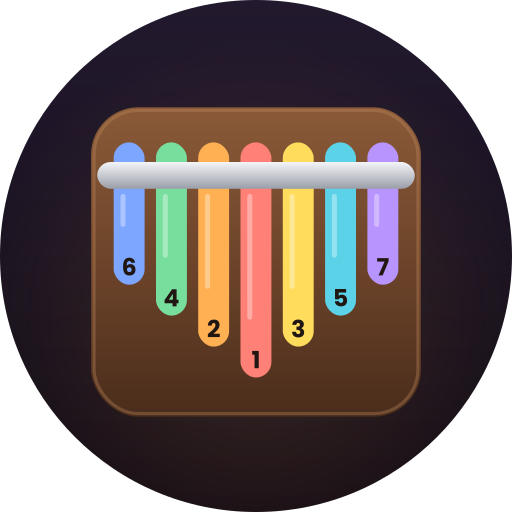
The 17 tines of a kalimba in C, from left to right as you hold it, with their number, letter, do-re-mi name and frequency. The long tine in the middle is 1, C4 (middle C); the notes go up outward, one side then the other.
The 17 tines, left to right
| Number | Letter | Do-re-mi | Tine, from the middle | Hz |
|---|---|---|---|---|
| 2 (2°°) | D6 | re | 8th left | 1174.66 |
| 7 (7°) | B5 | ti | 7th left | 987.77 |
| 5 (5°) | G5 | sol | 6th left | 783.99 |
| 3 (3°) | E5 | mi | 5th left | 659.26 |
| 1 (1°) | C5 | do | 4th left | 523.25 |
| 6 | A4 | la | 3rd left | 440.00 |
| 4 | F4 | fa | 2nd left | 349.23 |
| 2 | D4 | re | 1st left | 293.66 |
| 1 | C4 | do | middle (longest) | 261.63 |
| 3 | E4 | mi | 1st right | 329.63 |
| 5 | G4 | sol | 2nd right | 392.00 |
| 7 | B4 | ti | 3rd right | 493.88 |
| 2 (2°) | D5 | re | 4th right | 587.33 |
| 4 (4°) | F5 | fa | 5th right | 698.46 |
| 6 (6°) | A5 | la | 6th right | 880.00 |
| 1 (1°°) | C6 | do | 7th right | 1046.50 |
| 3 (3°°) | E6 | mi | 8th right | 1318.51 |
Frequencies in hertz with A4 = 440 Hz, equal temperament: what a tuner shows. To hear each note, see how to tune a kalimba.
8, 10 and 17 keys
Kalimbas in C share the same numbers; a bigger kalimba only adds higher notes.
| Kalimba | Notes, low to high | Numbers | Range |
|---|---|---|---|
| 8 keys | C4 D4 E4 F4 G4 A4 B4 C5 | 1 2 3 4 5 6 7 1° | C4 to C5 |
| 10 keys | C4 D4 E4 F4 G4 A4 B4 C5 D5 E5 | 1 2 3 4 5 6 7 1° 2° 3° | C4 to E5 |
| 17 keys | C4 D4 E4 F4 G4 A4 B4 C5 D5 E5 F5 G5 A5 B5 C6 D6 E6 | 1 2 3 4 5 6 7 1° 2° 3° 4° 5° 6° 7° 1°° 2°° 3°° | C4 to E6 |
On a 10-key and a 17-key kalimba the lowest tine is usually in the middle, with the notes going outward left and right in turn. On 8-key kalimbas the layout depends on the maker (some go from low on one side to high on the other): trust the numbers or letters engraved on the tines. See the songs that fit an 8-key kalimba.
How the octave is written: 1°, 1' and 1̇
- 1̇ (a dot above): the usual way in printed tabs and on engraved tines, and in our coloured tabs: 1 is C5, one octave above the middle 1. Two dots, 1, is C6.
- 1° or 1': the same thing in plain text, where a dot cannot sit above a number (our copied tabs and
.txtfiles use 1° and 1°°). Some apps write 1* or 1^. - 1̣ (a dot below): one octave lower, in some books. A 17-key kalimba in C has nothing below the middle 1.
Do-re-mi: some countries say si instead of ti for 7. In fixed do (France, Italy, Spain…), do is always C, so on a kalimba in C the numbers, the letters and do-re-mi always match.