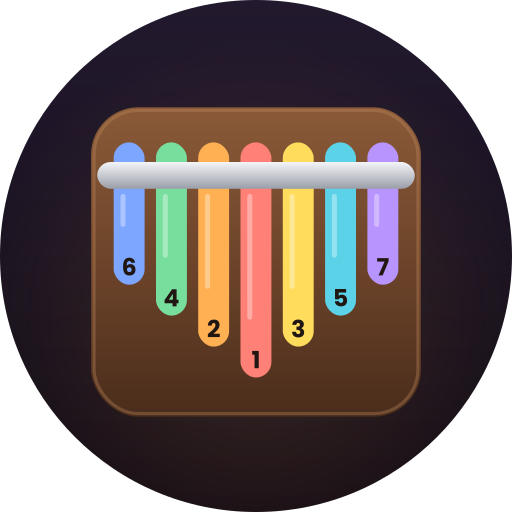
How to read kalimba numbers
Kalimba tabs in numbers are the easiest way to play: no staff, no notes to learn. Each tine of your kalimba has a number from 1 to 7, and a tab is just the list of numbers to play, in order.
1. The numbers are the notes of the scale
On a 17-key kalimba in C, 1 is C (do), 2 is D (re), 3 is E (mi), and so on up to 7, B (ti).
Most kalimbas come with the numbers engraved on the tines. If yours has letters (C D E…) or nothing, the free sticker sheet has a sticker for each tine, in the same colours as our tabs.
2. Where each tine is
The longest tine, in the middle, is the low 1. The next notes go outward, one on each side in turn: 2 on the left, 3 on the right, 4 on the left, 5 on the right… The shorter the tine, the higher the note. Your left thumb plays the left half, your right thumb the right half.
3. A dot above means higher
After 7, the scale starts again one octave higher: those numbers carry a dot above them. Two dots: one more octave. So 1 is the long middle tine, 1 with a dot is the C an octave up (fourth tine on the left of the middle), and 1 with two dots the C above that (second tine from the right end).
A dot below a number, in other books, means the opposite: one octave lower. On a 17-key kalimba in C nothing goes below the middle 1, so our tabs only have dots above.
4. Dashes, circles, words and thumbs
- A dash ( – ) after a number: let it ring one eighth more (two dashes: two eighths, and so on).
- A circle ( ○ ): a rest, one eighth of silence before the next number.
- The word under a number is the syllable sung on it (“ mat- ” goes on in the next one): sing along and the rhythm comes by itself.
- L or R: the thumb that plays it. Thumbs take turns most of the time, because the tines alternate.
5. Try it: Bella Ciao
The first two lines of Bella Ciao:
Play them slowly, then watch the video and go on with the rest of the song.
Tuning check
These tabs are for a 17-key kalimba in C, the most common one, from C4 (the middle tine) to E6. If your kalimba has 8 or 10 keys, the songs without dots still work on it; if it is tuned in another key, the numbers still give the right tune, only higher or lower.